
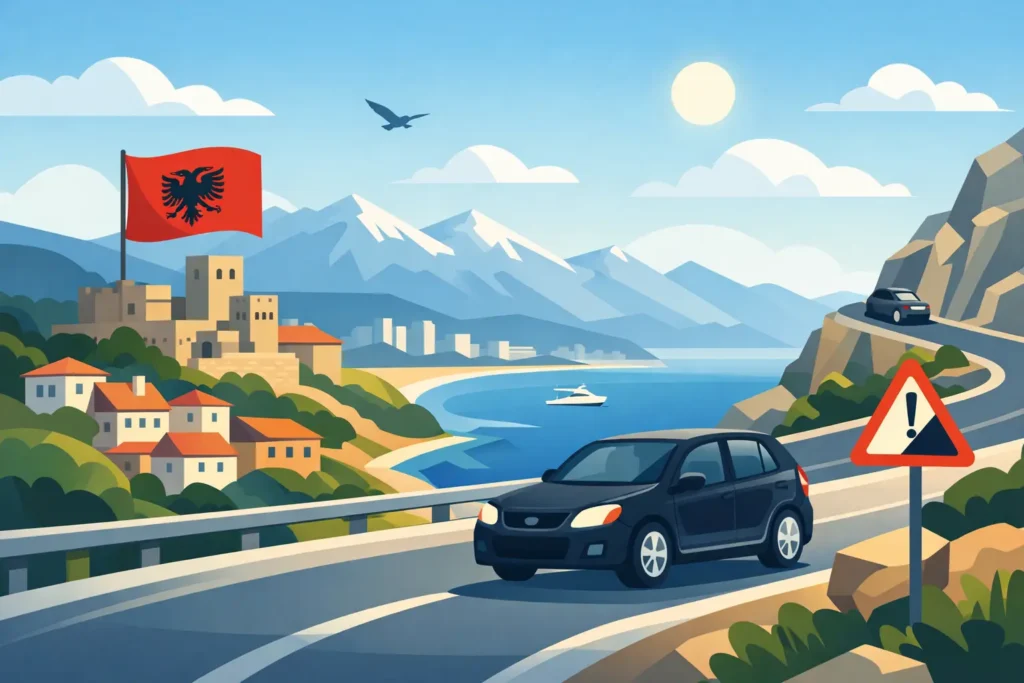
Landing at Tirana Airport and heading straight for the coast sounds easy on paper. The question most first-time visitors ask is simpler and more honest: is it safe to drive Albania? The short answer is yes, for most travelers it is. The better answer is that driving in Albania is safe when you arrive prepared, stay alert, and adjust to a road culture that can feel more energetic than what many US drivers are used to.
For travelers who want flexibility, a rental car opens up the trip in a way buses and taxis rarely can. You can move from Tirana to Berat, continue to Vlore, and reach the southern beaches on your own schedule. That freedom is real. So is the need to understand what driving here actually feels like.
Is it safe to drive Albania for tourists?
Yes, Albania is generally safe to drive for tourists, especially during daylight hours and on main travel routes. The biggest concern is usually not crime or personal safety. It is adapting to local driving habits, changing road quality, mountain routes, and occasional unpredictability.
If you have driven in Southern Europe, the Balkans, or busy Mediterranean cities, Albania will probably feel manageable after the first hour or two. If you are used only to quiet suburban roads in the US, the experience may feel faster, tighter, and less rule-bound at first.
That does not mean it is unsafe. It means you should expect a learning curve.
What makes driving in Albania feel challenging
The first surprise for many visitors is that conditions can change quickly. A modern highway can turn into a narrower local road within minutes. In city areas, traffic can be dense and assertive. In rural zones, you may come across sharp bends, uneven pavement, tractors, stray dogs, or pedestrians walking close to the road.
Local drivers often move decisively. They may follow more closely than you expect, overtake when there seems to be limited space, or treat lane markings as flexible. This sounds dramatic when written down, but in practice it usually means you need to stay calm, keep your distance, and avoid hesitant driving.
Confidence matters. Aggression does not.
Road conditions depend on where you go
The route from Tirana to Durres is very different from a mountain road near Theth or a winding coastal stretch south of Vlore. Major roads connecting key cities and airports have improved significantly, and many of the roads travelers use most are perfectly reasonable for a standard rental car.
The more remote your itinerary, the more selective you should be. Some scenic areas are beautiful precisely because they are less developed. That can mean narrow roads, loose gravel, limited lighting, and fewer services nearby. If your plan includes mountain villages or secluded beaches, it is smart to check the route in advance and choose a vehicle that matches the terrain.
City driving vs. coastal and mountain routes
Tirana is often the most stressful place to drive, not because it is dangerous in an extreme sense, but because it is busy. Traffic circles, frequent stops, dense traffic, and limited parking require patience. If you are arriving after a long flight, you may prefer to keep your first drive simple and avoid peak traffic hours.
Once you leave the capital, many travelers find the experience more enjoyable. Coastal drives can be beautiful and surprisingly smooth, though summer traffic near popular beach towns can be heavy. Mountain roads require more focus. They are often safe enough in dry weather, but they reward slower speeds, daylight driving, and a driver who is comfortable with steep climbs and tight turns.
Is night driving a good idea?
Usually, daytime is the better choice, especially for first-time visitors. At night, reduced visibility makes it harder to spot potholes, animals, road-edge hazards, and pedestrians. Some rural roads have limited lighting, and signs may be easier to miss after dark.
If your route is between major towns on familiar roads, night driving can be fine. But if you are new to Albania, arriving late, or heading into mountainous or rural areas, daylight gives you a much easier and more relaxed start.
The practical safety issues most travelers should know
Driving safely in Albania is less about worrying and more about adjusting your expectations. Roads do not always operate with the same rhythm or predictability you might expect in the US. A little preparation goes a long way.
Speed limits exist and should be respected, but do not assume every other driver will move at the posted pace. Seat belts are essential. Using your phone while driving is a bad idea anywhere, and even more so on roads where conditions can change quickly. Navigation apps help, but do not rely on them blindly in remote areas.
Fuel stations are easy to find on major routes, but become less frequent in rural regions. If you are heading far from a city or coastal hub, do not wait until the tank is nearly empty.
Parking and vehicle security
For most visitors, Albania is not a place where car theft is the main concern. Basic travel habits are enough. Lock the car, do not leave valuables visible, and use attended or clearly designated parking when possible.
Parking in city centers can be tight, and informal parking habits are common. That does not always mean unsafe, but it does mean you should be careful about where you leave the vehicle. In beach towns and busy summer areas, arriving earlier often makes parking much easier.
Who will feel comfortable driving here?
Most confident travelers do well. If you are comfortable with roundabouts, lane merges, moderate traffic pressure, and roads that are not always perfectly marked, you will likely adjust quickly.
Families often enjoy driving in Albania because it makes luggage, beach gear, and day trips much easier. Couples like the flexibility of changing plans on the fly. Diaspora visitors may already know the rhythm of local roads, even if they have not driven here recently.
The travelers who struggle most are usually those who are extremely anxious behind the wheel or expect every road environment to feel highly regulated and perfectly uniform. If that sounds like you, it may still be doable, but choosing simpler routes and a newer, easy-to-drive car makes a real difference.
How to make driving in Albania feel easy
The safest approach is also the simplest. Choose a route that matches your confidence level. Start with major roads before taking on mountain drives. Avoid rushing after arrival. Keep extra space around you. Drive defensively, not fearfully.
Vehicle choice matters more than people think. A compact automatic is ideal for many city-and-coast itineraries. If your trip includes rougher terrain or remote areas, more clearance may be worth it. A modern rental vehicle with clear terms, dependable support, and straightforward pickup removes a lot of unnecessary stress before the trip even begins.
That is one reason travelers who want a worry-free journey often book with providers that focus on newer cars, easy formalities, and transparent conditions. The less time you spend decoding rental rules, the more attention you can give the road.
When driving in Albania may not be the best option
There are cases where renting a car is not the smartest move. If you plan to stay only in central Tirana, you may not need one every day. If you are uncomfortable driving on mountain roads, a transfer for that part of the journey might be better. And if your itinerary is extremely short, private transport can sometimes be simpler.
Still, for travelers visiting multiple destinations, driving is often the best balance of comfort, speed, and independence. Albania rewards flexibility. Some of its best beaches, villages, and viewpoints are easier to enjoy when you are not working around a bus schedule.
So, is it safe to drive in Albania?
Yes, it is safe to drive in Albania for most tourists, and far safer than many first-time visitors expect. The key is to treat it as a real driving environment, not a casual add-on to the trip. Stay alert, drive in daylight when possible, choose the right vehicle, and give yourself time to settle into the pace.
Once you do, Albania becomes the kind of place that is best experienced on four wheels – where a comfortable car, a clear route, and a little confidence can turn the trip from practical to memorable.
If you like traveling on your own schedule, Albania is worth driving. Just give the road the respect it deserves, and the journey tends to reward you.